Mejora del diagnóstico de psoriasis pustulosa generalizada con Legit.Health como herramienta de apoyo: estudio multilector y multicaso
Un estudio multilector y multicaso revisado por pares observó que Legit.Health mejoró un 22,97 % la precisión diagnóstica de la psoriasis pustulosa generalizada.
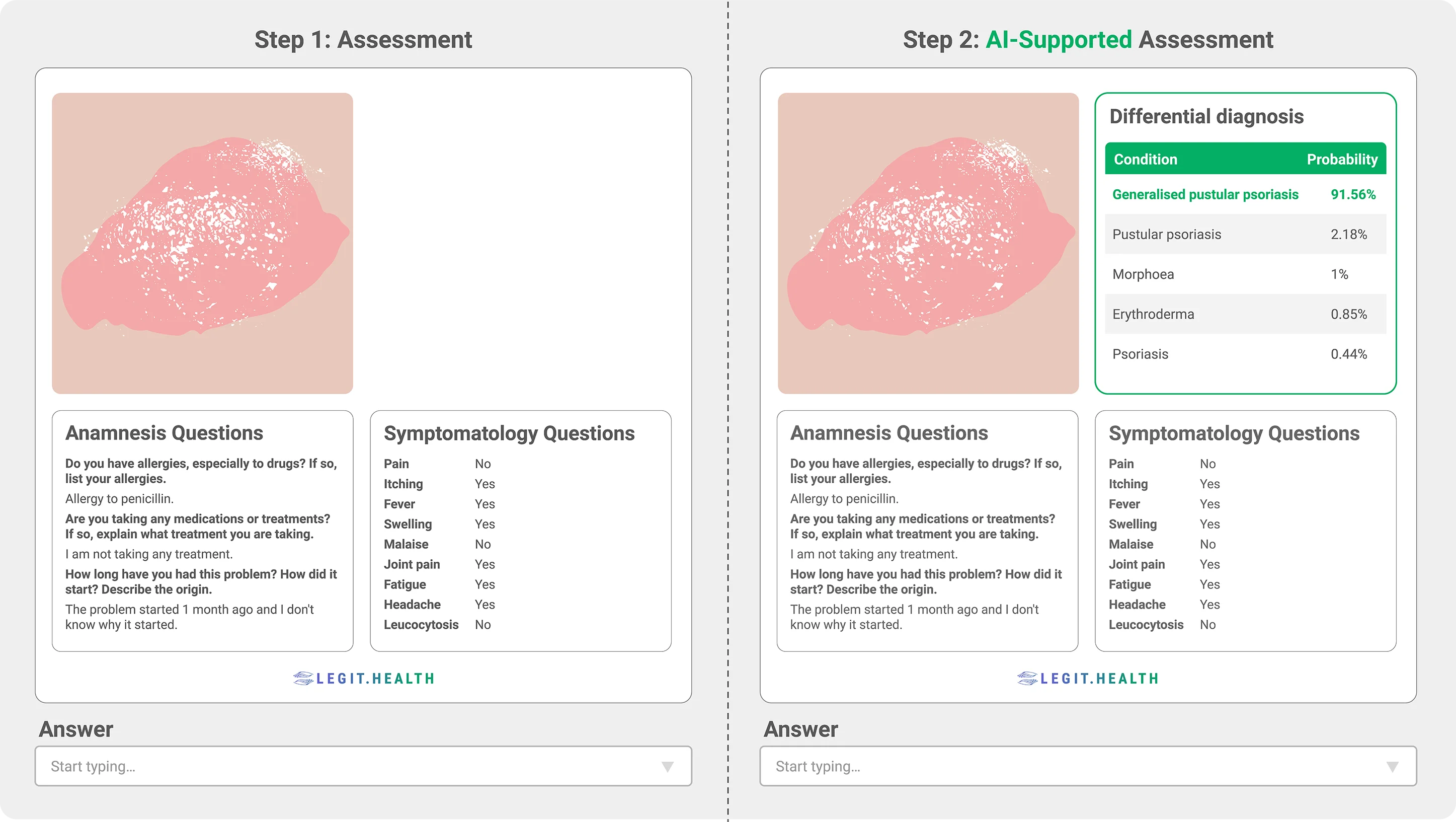
Enhanced Diagnosis of Generalized Pustular Psoriasis With the Legit.Health Device as a Diagnosis Support Tool: Multireader Multicase Study
Authors
Alfonso Medela, Ignacio Hernández Montilla, Alberto Sabater, Andy Aguilar, Taig Mac Carthy, Gurpreet Singh Chowdhry, Juan Semeco, Antonio Martorell.
Introduction
Generalized Pustular Psoriasis (GPP) is a rare, severe, and potentially life-threatening form of psoriasis characterized by widespread sterile pustules on erythematous skin. Unlike plaque psoriasis, GPP can present acutely with systemic symptoms including fever, malaise, and laboratory abnormalities.
Due to its rarity (affecting fewer than 1 in 10,000 people) and the clinical overlap with other pustular conditions, GPP presents significant diagnostic challenges:
- Limited specialist access: Many dermatologists see few GPP cases in their careers
- Diagnostic delays: Patients may be misdiagnosed with other conditions
- Urgent treatment needs: GPP flares require prompt recognition and intervention
- Monitoring challenges: Assessing disease activity and treatment response
Objective
This study evaluated the diagnostic performance of the Legit.Health medical device for GPP and measured whether its diagnostic suggestions improved health care practitioners’ ability to identify this rare disease.
Method
The disease-recognition model was fine-tuned with 4,397 new GPP images. Fifteen health care practitioners, including 11 primary care practitioners and 4 dermatologists, then reviewed 100 images spanning 15 visually similar skin conditions. Each participant made an initial diagnosis before receiving the device’s five most likely conditions and recording an assisted diagnosis.
Results
Legit.Health achieved top-1, top-3, and top-5 sensitivity of 0.80, 0.86, and 0.90, with specificity of 0.99, 0.99, and 0.96. In the prospective reader study, assistance from the device increased diagnostic accuracy for GPP by 22.97% overall, including gains of 24.24% for primary care practitioners and 19.45% for dermatologists.
Limits and interpretation
This was an image-reading study with 15 practitioners and 100 images, not a study of real-world diagnoses, treatment decisions, or patient outcomes. The reader group included four dermatologists, and participants chose among image-based possibilities without the full context of an in-person consultation.
The paper reports that the device improved accuracy in this controlled reader study. It does not establish that using the device reduces diagnostic delays or improves outcomes in clinical practice. Several authors were affiliated with Legit.Health, the device evaluated, and the study was funded by Boehringer Ingelheim.
Final peer-reviewed publication
This is the final peer-reviewed article, published in JMIR Dermatology, volume 9, article e82030, on 10 June 2026. Available at https://doi.org/10.2196/82030.
Investigación relacionada
AEDV 2022: Cálculo automático de la urticaria con inteligencia artificial
Cálculo automático de la urticaria mediante inteligencia artificial para el recuento preciso de habones.
Leer publicaciónAEDV 2023: Validación de un algoritmo de deep learning para el diagnóstico de melanoma
Resultados del estudio de validación de un algoritmo de deep learning para el diagnóstico de melanoma.
Leer publicaciónSistema automático internacional de puntuación de la gravedad de la hidradenitis supurativa (AIHS4): una nueva herramienta de inteligencia artificial
Sistema de inteligencia artificial para evaluar automáticamente la gravedad de la hidradenitis supurativa con un rendimiento comparable al de especialistas.
Leer publicación¿Te interesa la IA médica?
Conoce Legit.Health y nuestro trabajo en inteligencia artificial dermatológica.
Explorar Legit.Health