Artificial Intelligence-Based Quantification to Assess the Automatic Psoriasis Area and Severity Index
A study of automated erythema, induration, desquamation, and lesion-area assessment for psoriasis severity scoring.
Artificial Intelligence-Based Quantification to Assess the Automatic Psoriasis Area and Severity Index
Authors
Taig Mac Carthy, Daniel Dagnino, Alfonso Medela, Gerardo Fernández, Andy Aguilar, Antonio Martorell, Pedro Gómez-Tejerina, Gastón Roustán-Gullón.
Abstract
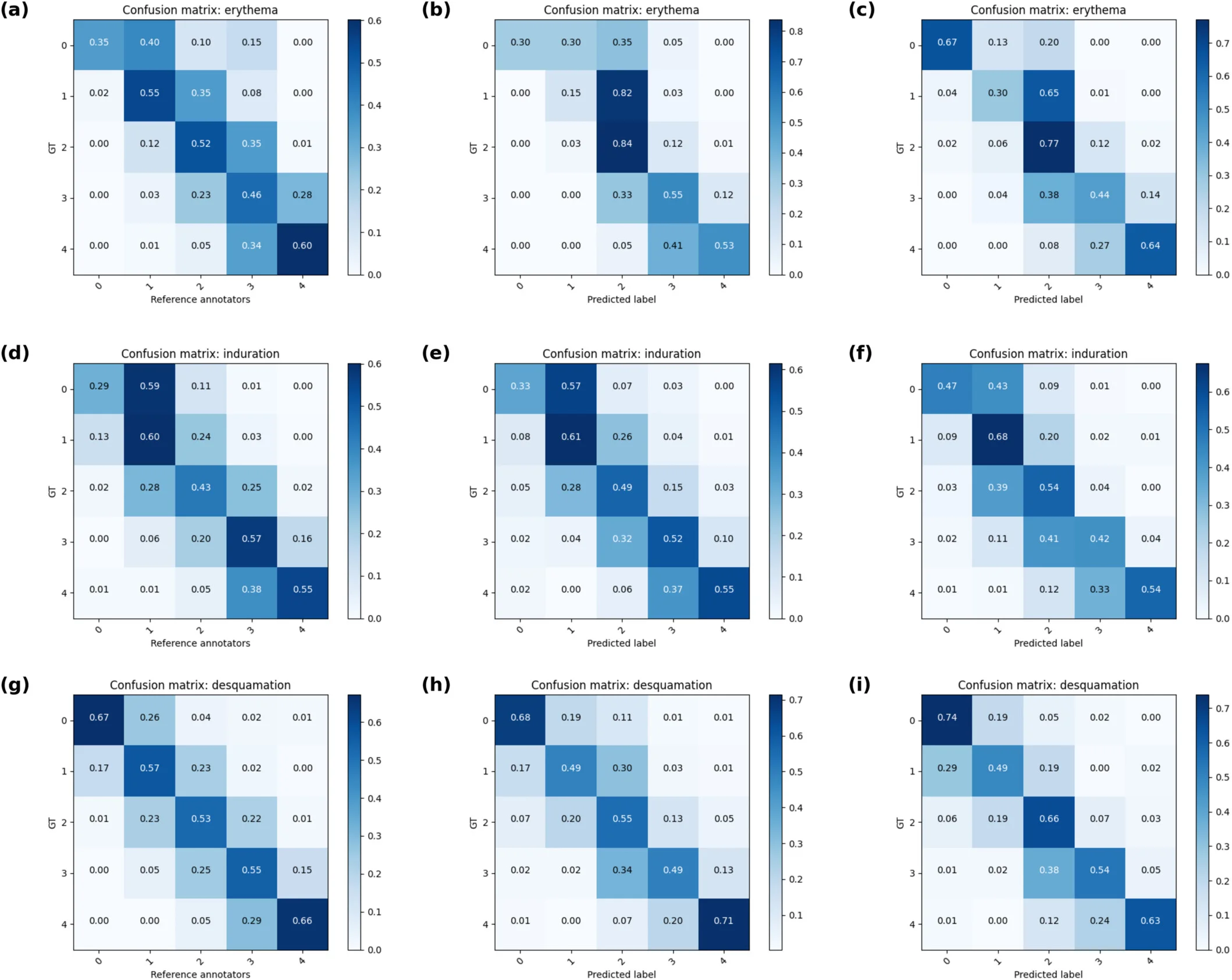
The Psoriasis Area and Severity Index is widely used in clinical practice and trials, but scoring is time-consuming and can vary between observers. This study evaluated automated methods for rating erythema, induration, and desquamation and for segmenting psoriatic lesions from clinical photographs.
The analysis used 2,857 images annotated independently by three dermatology experts. Among the tested classification models, MiT_b2 achieved accuracies of 60.6% for erythema, 54.3% for induration, and 61.8% for desquamation. For lesion segmentation, Xception achieved an intersection over union of 0.752.
The findings support the feasibility of automated, reproducible assessment of PASI components while identifying room for further validation and model improvement.
Publication
Published in JEADV Clinical Practice, volume 5, pages 82-90. First published online on 8 October 2025.
Available at https://doi.org/10.1002/jvc2.70143.
Related Research
AEDV 2022: Automatic urticaria scoring with artificial intelligence
Automatic urticaria scoring using artificial intelligence for precise hive counting. Presentation delivered in Spanish.
Read publicationAEDV 2023: Validation of a deep-learning algorithm for melanoma diagnosis
Results from validating a deep-learning algorithm for melanoma diagnosis. Presentation delivered in Spanish.
Read publicationAutomatic International Hidradenitis Suppurativa Severity Score System (AIHS4): A Novel Tool to Assess the Severity of Hidradenitis Suppurativa Using Artificial Intelligence
An artificial-intelligence system for automatically assessing hidradenitis suppurativa severity with performance comparable to expert assessment.
Read publicationInterested in medical AI?
Learn more about Legit.Health and our work in dermatology AI.
Explore Legit.Health