Artificial Intelligence-Based Quantification to Assess the Automatic Psoriasis Area and Severity Index
A study of automated erythema, induration, desquamation, and lesion-area assessment for psoriasis severity scoring.
Read publicationResearch, tools, and resources
Work in artificial intelligence focuses on evaluating clinical image-analysis methods for dermatology. Work in psychology focuses on making complex models and neuroanatomy easier to explore.
Discipline 01
Research on deep learning and computer vision in dermatology, including studies of automatic severity scoring, image quality assessment, and diagnostic support, conducted with colleagues at Legit.Health.
ORCID 0000-0001-5583-5273Selected papers
The papers I find most important and interesting are presented first.
A study of automated erythema, induration, desquamation, and lesion-area assessment for psoriasis severity scoring.
Read publicationA study introducing an automatic Urticaria Activity Score based on deep-learning hive detection and counting.
Read publicationJournal articles, meeting abstracts, and scientific conference presentations.
A novel AI tool for automatic acne severity assessment, evaluated against dermatologists using the IGA and GAGS clinical scales.
Read publicationA July 2026 meeting abstract on an AI-driven approach to Vitiligo Area Scoring Index assessment.
Read publicationA multireader multicase study found that Legit.Health improved clinician diagnostic accuracy for generalized pustular psoriasis by 22.97%.
Read publicationA cross-domain image-quality study combining dermatology and general-purpose datasets to improve robustness with limited clinical data.
Read publicationAn artificial-intelligence system for automatically assessing hidradenitis suppurativa severity with performance comparable to expert assessment.
Read publicationA validation-set study of a neural network that predicted perceived quality scores for dermatology images.
Read publicationA retrospective pilot study of automated atopic-dermatitis sign and lesion-area assessment from clinical images.
Read publicationResults from validating a deep-learning algorithm for melanoma diagnosis. Presentation delivered in Spanish.
Read publicationDeep-learning algorithm for optimising the triage and referral of patients with skin conditions. Presentation delivered in Spanish.
Read publicationAutomatic urticaria scoring using artificial intelligence for precise hive counting. Presentation delivered in Spanish.
Read publicationDiscipline 02
Interactive resources for exploring neuroanatomy, built to keep complex material legible and useful while preserving links to source literature.
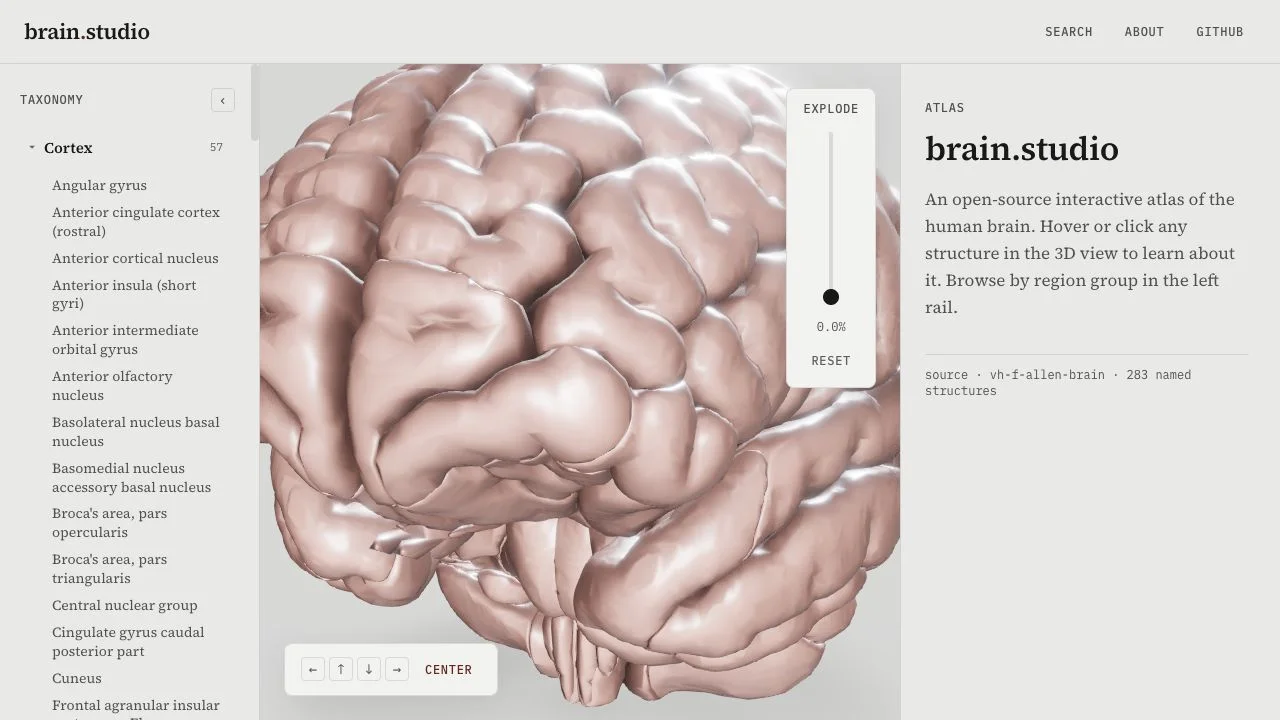
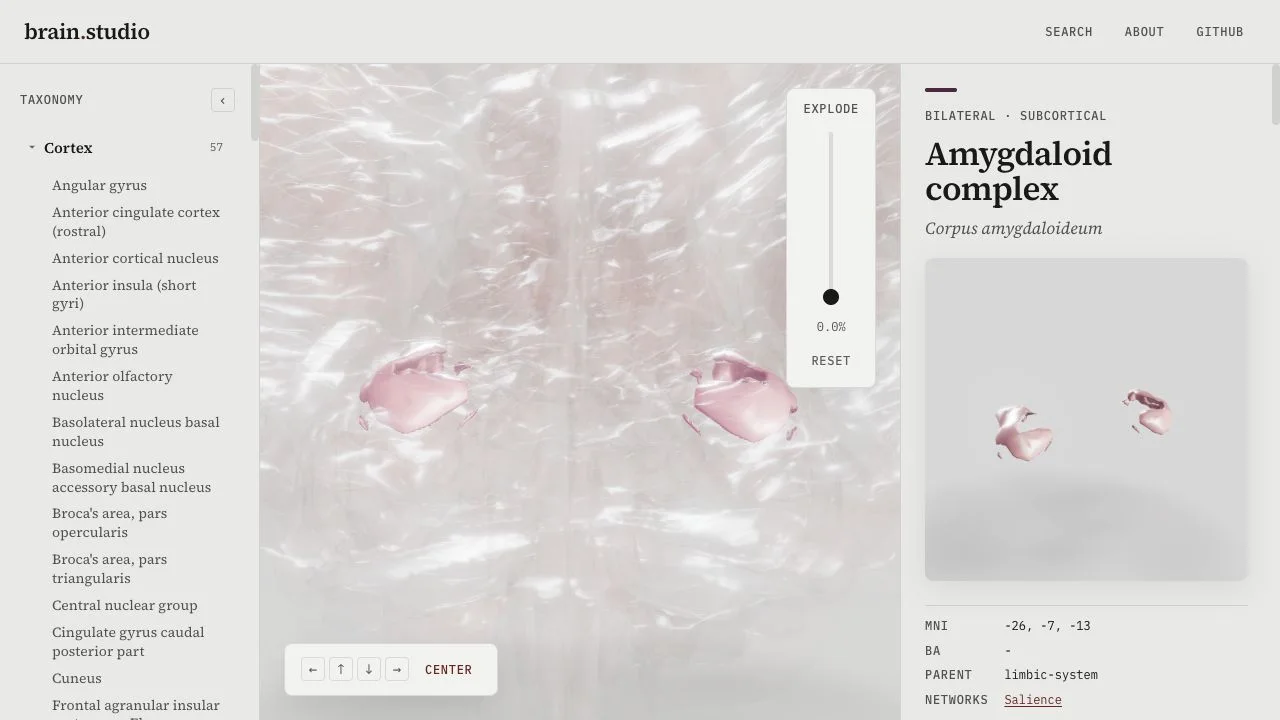
An interactive 3D atlas of the human brain. Explore individual structures and functional networks, then follow each deep link into concise notes on function, connections, clinical correlates, and source literature.
Assessment archive
Seven browser-based questionnaires previously appeared here. They were removed after a source and licensing review found that two instruments did not permit this public administration, one calculator scored its source scale incorrectly, and four lacked a held licence or adequate validation record. The authoritative publisher and author pages below are safer starting points. These links are references, not personal assessment or clinical advice.